How Much Does Employee Turnover Actually Cost?
The real math behind employee turnover costs, with a free calculator. Replacement cost by role, the hidden costs nobody budgets, and the preventable slice.
By Blake Johnston
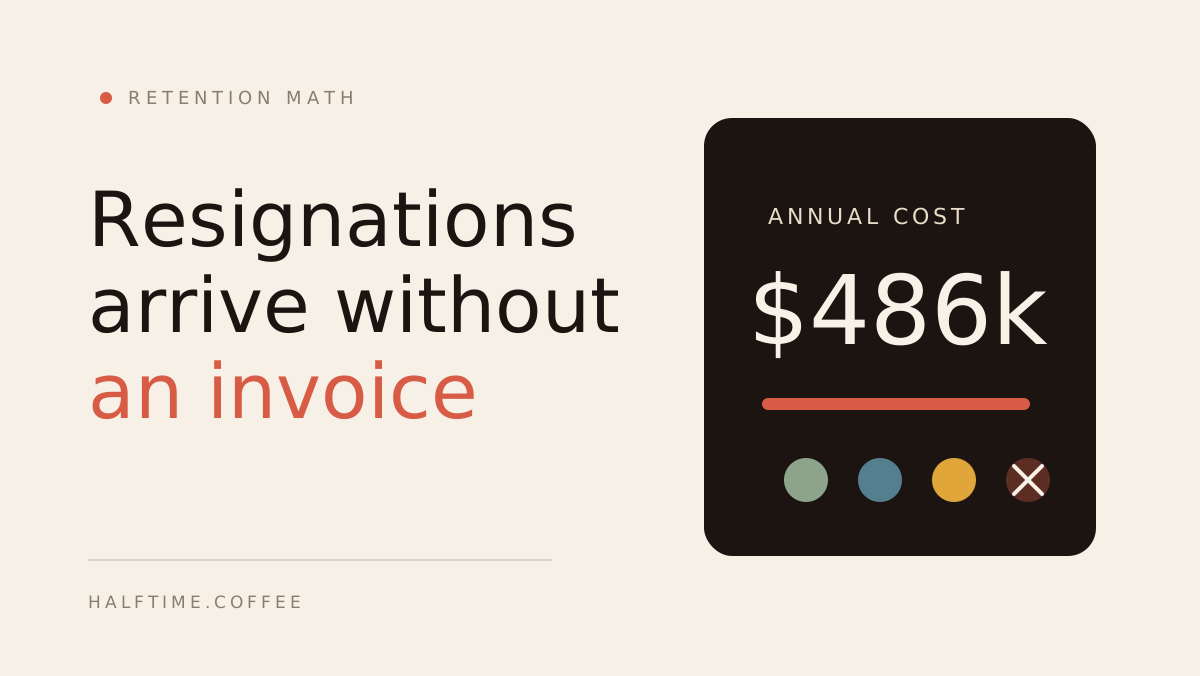
The resignation email is two paragraphs. Polite, appreciative, gone in four weeks.
Nobody attaches an invoice to it. So the finance system never sees the recruiter fee, the four months of a half-empty seat, the onboarding time, the six months of ramp, or the two teammates who quietly opened LinkedIn the week after. The email costs nothing. The departure costs a large fraction of a salary, and at most companies nobody ever adds it up.
Here is the math, and a free calculator that adds it up for you.
If you are already convinced the cost is real and need the practical playbook, use employee retention strategies for small teams. If the internal debate is whether this belongs to engagement or retention, start with employee engagement vs employee retention.
The actual math
Three numbers. Headcount, turnover rate, and the cost to replace one person.
headcount x turnover rate = departures per year
departures x (salary x replacement %) = annual cost of turnover
The replacement percentage is the number people argue about, so use a planning range by role rather than one universal figure. Industry studies from SHRM put the average cost per hire around $4,700 before a minute of training happens, and Gallup's replacement estimates run from half of annual salary up to double it for senior roles.
A practical set of presets, the same ones the turnover cost calculator uses.
| Role type | Cost to replace | Why |
|---|---|---|
| Frontline | 30% of salary | Faster to hire, faster to ramp, but volume is high |
| Professional | 75% of salary | Recruiter fees, long vacancies, months of ramp |
| Manager or specialist | 150% of salary | Long searches, slow ramp, and the team dips while the seat is empty |
Worked example. A 40-person company, average salary $90k, 18 percent annual turnover. That is 7.2 departures a year. At the professional preset, each one costs $67,500 to replace.
7.2 x $67,500 = $486,000 a year.
Roughly five salaries, spent replacing people instead of employing them. And that is the mid preset. If two of those departures are managers, the number climbs fast. One $140k manager at the 150 percent preset is $210,000 on their own.
Where the money actually goes
The recruiter invoice is the only part of turnover that arrives looking like a cost. Everything else dissolves into the payroll you were spending anyway, which is why it never gets budgeted.
The vacancy. The average seat stays empty for weeks or months. The work does not pause. It lands on the rest of the team, who do it slower, later, or not at all. Deadlines stretch. Nobody writes "vacancy drag" on the project retro, but that is what it was.
The exit itself. The last month of a departing employee is not their most productive. Handover docs, knowledge transfer calls, the goodbye lunch. All paid time, none of it building anything.
Onboarding and ramp. A new professional hire takes months to reach the output of the person they replaced. You pay full salary for partial output the entire time, and a chunk of a senior teammate's time goes into training instead of their own work.
The knowledge that walks out. The undocumented context, the customer relationships, the "ask Dana, she knows why we did it that way." You find out what it was worth over the following year, one small mistake at a time.
The second-order departures. This is the one that turns a bad quarter into a bad year. Departures are contagious. When someone leaves, their closest workmates re-evaluate. If the person who left was the reason the team felt like a team, the next resignation is often already in draft.
The presets above are conservative precisely because these costs are real but fuzzy. If your gut says 75 percent of salary is too high, the fuzzy half of this list is the part your gut is leaving out.
The preventable slice
Here is the part worth acting on. A large share of that $486,000 did not have to happen.
Gallup estimates 42 percent of voluntary turnover is preventable. Not with counteroffers on resignation day, which mostly buy an awkward six-month delay. Preventable earlier, when the leaving was still a feeling rather than a plan.
People rarely leave purely over money. They leave when the job stops feeling like theirs. Disconnected from the team, unseen by their manager, unclear on what comes next. Every one of those develops quietly, over months, while the person still shows up and does fine work. Which means every one of them has a window where a team can do something about it.
On the worked example above, 42 percent of $486,000 is about $204,000 a year sitting in that window. The calculator lets you set your own preventable share and shows you the slice in dollars.
What actually moves the number
Exit interviews measure the leak after the water is gone. The useful work happens earlier, and the highest-leverage versions are cheap.
The first 90 days. New hires decide early whether they belong. A deliberate first-week and first-quarter plan beats an expensive perks program, because the question a new hire is actually asking is "do these people know I exist."
One-on-ones that surface problems while they are small. Most managers run status meetings and call them one-on-ones. The retention version asks different questions. There is a free bank of one-on-one questions built for exactly that.
Daily connection, not quarterly events. The offsite is a photo. The daily two minutes is a relationship. Gallup's engagement research keeps landing on the same point, that having real friendships at work is one of the strongest predictors of staying. Rituals beat events because connection compounds daily, and that is the entire design bet behind Halftime for staff retention.
Act on what you already know. If you run engagement surveys, the survey is not the work. What you do in the two weeks after it is the work. Teams notice when nothing changes, and they update their plans accordingly.
None of this shows up as a line item, which is exactly the trap. The costs of turnover are invisible until someone resigns, and the costs of preventing it are visible every day. Budgets reward the wrong direction.
The bottom line
Turnover is one of the largest controllable costs in the company and one of the only ones with no owner. Finance sees recruiter fees. Managers see a hard quarter. HR sees a rate on a dashboard. Nobody sees $486,000, because it never arrives as a single number.
So make it one. Run your headcount, salary, and turnover rate through the calculator, look at the preventable slice, and then compare it to the cost of the things that actually keep people. A real first 90 days. Real one-on-ones. A team that feels like a team every day, not once a quarter.
The replacement invoice always gets paid. The prevention budget has to be argued for. This is the argument.
The preventable slice of turnover is mostly a connection problem. Halftime gives your team a daily two-minute ritual that keeps belonging from quietly eroding, async, no extra meeting. Free for 30 days, no card needed.
FAQ
Common questions
How much does employee turnover cost?
Replacing one employee typically costs a large share of their annual salary. A practical planning range is 30 percent of salary for frontline roles, 75 percent for professional roles, and 150 percent or more for managers and specialists. That covers recruiting, the vacancy period, onboarding, and the months it takes a new hire to reach full productivity. For a 40-person company with average salaries of $90k and 18 percent annual turnover, the yearly bill lands around $486,000.
How do you calculate the cost of employee turnover?
Multiply your headcount by your annual turnover rate to get the number of departures per year. Multiply that by the cost to replace one person, which is a percentage of their salary based on role seniority. Headcount x turnover rate x (salary x replacement percentage) gives you the annual cost of turnover.
How much employee turnover is preventable?
Gallup estimates 42 percent of voluntary turnover is preventable. People rarely leave purely over pay. They leave when they feel disconnected from the team, unseen by their manager, or unclear on their future, and all three are things a team can influence before the resignation letter, not after.
Why does replacing a manager cost 150 percent of their salary?
Manager and specialist roles take longer to fill, cost more to recruit, and take longer to ramp. While the seat is empty, the team they ran performs worse, decisions stall, and the people who reported to them become flight risks themselves. The salary multiple is high because the blast radius is bigger.
What is the cheapest way to reduce turnover costs?
Work on the departures you can still prevent rather than the ones already in motion. The highest-leverage windows are the first 90 days of a new hire, regular one-on-ones that surface problems early, and a daily team connection ritual that keeps belonging from quietly eroding. All three cost close to nothing compared to one replacement.