Solutions · Staff retention
People stay where they're connected. Connection is built daily.
People leave when work starts feeling anonymous. Halftime gives teams one small daily ritual that helps people notice each other before disengagement becomes exit risk.
Built for connection · Full access for 30 days · No surveys
Evaluating for your team? Book a 15-min walkthrough →
People don't leave jobs. They leave teams they never connected with.
Gallup's research is unambiguous: people are more engaged when they have a close friend at work, and Gallup estimates 42% of voluntary turnover is preventable. The problem is that most retention tools diagnose risk after connection is already thin. Halftime builds the daily team connection those tools cannot create.
For the deeper argument behind the daily-ritual approach, see The Case →
Want the dollar figure for your team? Read what turnover actually costs or run the calculator.
Two minutes a day. Connection that compounds.
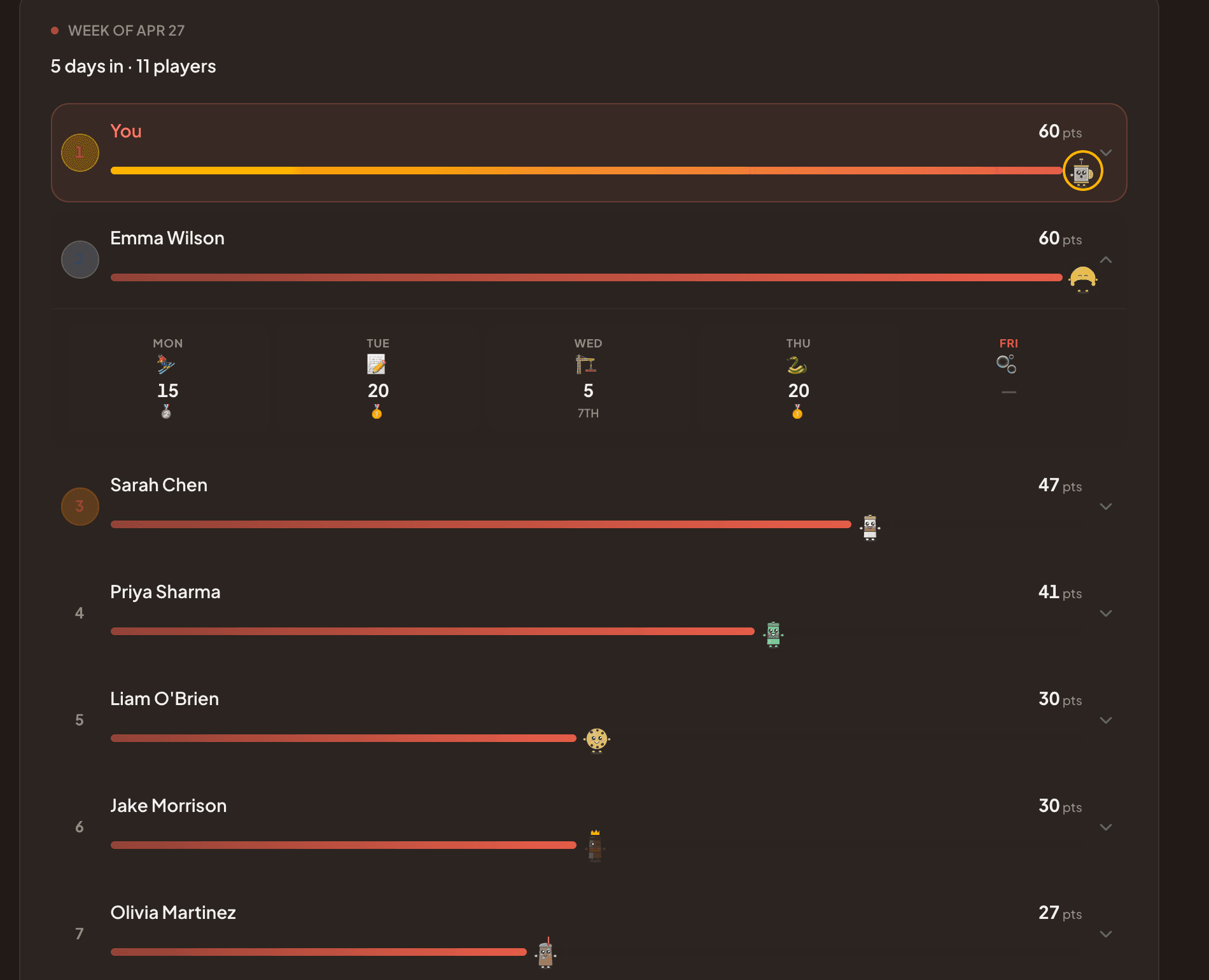
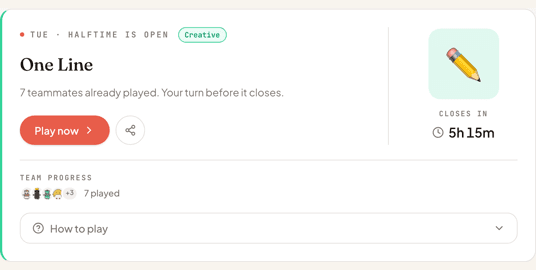
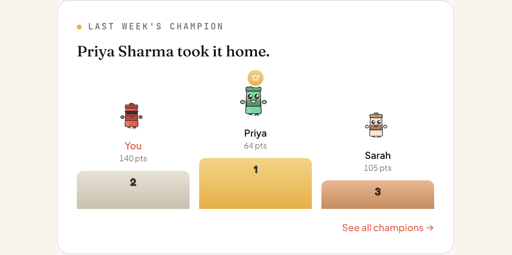
A new game opens at 9. Each team member plays whenever there's a moment. By 4pm scores reveal, the leaderboard updates, the conversation starts. Streaks form, rivalries develop, weekly champions emerge.
Why it matters
The team gets a reason to notice who showed up.
Streaks, champions, and tiny daily wins create the weak signals managers usually miss until someone is already checked out.
The early signs show up before retention does. Watch the ritual, not the exit interview.
Retention moves slowly, but the leading indicators show up fast.
Week 1
People start playing. Quiet teammates who never speak in meetings show up on the leaderboard.
Week 2
Streaks form. New hires get pulled into the banter. Mornings feel different.
Month 1
Inside jokes accumulate. Camera-off stand-ups get warmer. The team starts feeling like a team.
“The games have been really fun. The team has really enjoyed the various games. It came at a perfect time. We were experiencing low morale across the team and your app boosted morale within days.”
Retention pilot signals
What to watch before anyone resigns.
Retention is a lagging metric. A small pilot should look for earlier signals that the team is paying attention to each other again.
Return rate
Do people come back tomorrow without a manager reminding them?
Quiet participation
Do teammates who rarely speak in meetings show up in the ritual?
Team chatter
Do scores, prompts, or streaks create voluntary conversation?
New-hire pull
Do newer teammates get noticed before they have a reason to ask for help?
Common questions
Does this actually reduce turnover?+
Halftime alone doesn't fix retention. What it does is create a lightweight daily connection point around the team, which is one of the inputs Gallup links to engagement, intent to stay, and satisfaction. Treat it as a leading indicator, not a magic retention lever.
What if my team is already burned out on forced fun?+
Halftime is voluntary and async. No mandatory attendance, no video calls, no facilitator. People play because the games are genuinely fun, or they don't. Either way it isn't an obligation.
How much of my HR team's time does this take?+
Setup is about 30 seconds. Pick days, times, and game preferences. After that it runs itself. No facilitation, no content to create, no reports to chase.
Can we pilot it with one team first?+
Yes. Every team gets a 30-day free trial with full access and no credit card, so you can run a pilot with one team before expanding. After that you keep a daily puzzle for free or subscribe to Pro at $39/mo flat for the whole team. Larger orgs can request a custom Enterprise plan.
Go deeper
The retention playbook, in four reads.
How much does employee turnover actually cost?
The math, the hidden costs, and the preventable slice.
Employee retention strategies for small teams
Cheap, repeatable habits that keep people before anyone is a flight risk.
Employee engagement vs employee retention
One is the signal. The other is the outcome.
New employee first week plan
Retention starts before the new hire is fully useful.
Ready when you are
Try a game. Set up your team in a minute.
Free for 30 days, no card. Play one solo right now to see what your team would be doing.