7 Best Microsoft Teams Games for Work (No Installs)
Compare 7 Microsoft Teams games for work: async daily games, meeting openers, trivia, word games, and more. All are quick, browser-based, and need no installs.
By Blake Johnston
If you are looking for Microsoft Teams games for work, the best options are short, browser-based, and easy to join without turning a normal meeting into a forced social event.
Microsoft Teams is not where most people go looking for whimsy. That is fine. Work games do not need whimsy first. They need usefulness.
If you are asking the literal question, yes: Microsoft Teams can support games through meetings, chat, polls, apps, whiteboards, and browser links. The practical question is which games stay useful after the novelty wears off.
A good Microsoft Teams game should do one of three jobs: warm up a meeting, reset the room, or give a remote team a small shared moment without adding another call. Managers and People teams should choose the job first. If the game needs a fifteen-minute rules explanation, a host with theatre energy, or everyone pretending the calendar invite is fun, it is the wrong game for the team.
Teams-heavy companies usually have a different culture from Slack-heavy startups. More meetings. More departments. More recurring calls. More people joining from locked-down work laptops. The best Microsoft Teams games respect that. They are quick, browser-based, work-appropriate, and easy to skip without drama.
If you want the product version, Halftime shows how daily browser games can use Teams for reminders and results while keeping the actual play lightweight.
Quick answer: The Microsoft Teams games that stick are short, optional, and browser-based. Use a two-minute async daily game for recurring team connection, meeting openers, trivia, or word games for live calls, and live session games for socials, retros, and kickoffs.
Best Microsoft Teams games at a glance
| Game format | Best for | Live or async | Keep it to |
|---|---|---|---|
| Two-minute async daily game | Recurring team connection | Async | 2 minutes |
| Meeting opener games | Standups, retros, weekly meetings | Live | 3-5 minutes |
| Trivia | Light competition and team socials | Live or async | 5 questions |
| Word games | Camera-off or quiet Teams rooms | Live or async | 2-5 minutes |
| Estimation games | Low-stakes participation in chat | Live or async | 1 prompt |
| Drawing and creative prompts | Teams with existing trust and banter | Live | 5 minutes |
| Live session games | Socials, offsites, retros, kickoffs | Live | 10-30 minutes |
The big decision is cadence. If you need one lively moment during a meeting, use a meeting opener, trivia round, or live session game. If you need ongoing remote team connection, use an async daily game that can run through Teams without adding another call.
Which Microsoft Teams game is best for employee engagement?
For recurring employee engagement, start with an optional async game that takes two minutes and gives the whole team one shared result. Live games are better for a scheduled social or meeting opener. Surveys, recognition, and coffee chats solve different engagement problems; compare those in the Microsoft Teams engagement tools guide.
How we evaluated these game formats
We compared each format by time to explain, joining friction, live or async fit, optional participation, facilitator effort, and whether it can survive as a recurring work ritual. We also checked Microsoft's current Teams guidance on July 13, 2026. Halftime is our product and is the example used for the async daily-game format.
Microsoft's own Games for Work pilot app is no longer available; Microsoft updated its announcement in May 2024 to direct teams toward other social apps. That is why this guide focuses on current meeting features, Workflows, third-party apps, and browser-based games.
Teams notification setup in 2026
Microsoft's current admin documentation says legacy Microsoft 365 Connectors are nearing deprecation, with creation of new connectors due to be blocked. Microsoft recommends Workflows for webhook-style posting.
The practical answer: Teams Workflows webhooks work today; do not build a new integration on legacy connectors.
If you are setting up a recurring Teams game in 2026, use Microsoft's documented Teams Workflows webhook setup for channel reminders and result posts. If an older connector notification stops posting, migrate it to Workflows rather than assuming all incoming webhooks have been removed.
For the deeper breakdown, see Microsoft Teams incoming webhooks in 2026.
The Teams game test
Before you run a game in Microsoft Teams, ask three questions:
Does this fit the meeting, or is it trying to become the meeting?
Can everyone join without installing anything?
Will the quietest person in the room have a safe way to participate?
If the answer to any of those is no, choose something smaller.
The goal is not to make every meeting playful. The goal is to give the team a repeatable way to interact as people, not just agenda owners.
When Teams is enough, and when you need a game tool
Microsoft Teams is enough when the game is simple: a chat prompt, quick poll, one trivia question, or a short opener run by the meeting host.
Use Teams by itself when:
- The game is one prompt.
- The meeting host can explain it in one sentence.
- You do not need scoring, records, reminders, or a leaderboard.
- The team only plays occasionally.
Use a browser-based game tool when the ritual needs to repeat. Daily games, team records, weekly champions, result posts, and reminders should not depend on one manager remembering to run the activity.
That is the job Halftime is built for: Teams carries the reminder and result, while the actual game opens in the browser so nobody has to install another Teams app during the workday.
1. Two-minute async daily game
The best recurring Teams game often does not happen during a meeting at all.
It opens in the team's channel. People click through and play in the browser when they have a window. Results land later. The team gets a leaderboard, a record, a champion, or at least one person asking how someone else got that score.
That shape solves the biggest problem with Teams games: timing.
Live team games require everyone to be present and in the right mood at the same time. Async games give people a window. Someone plays between customer calls. Someone plays after school drop-off. Someone plays from another timezone while the rest of the team is offline.
The shared result still exists.
That is why async works better as a habit. Live games are useful punctuation. Async games are rhythm.
This is the exact shape Halftime is built around. The game opens in your Teams channel each morning, everyone plays in the browser on their own time, and results come back to the channel.
2. Meeting opener games
Sometimes you need a room to loosen up quickly.
Good meeting opener games should take less than five minutes and require almost no explanation. The best ones give people a specific action instead of asking them to be interesting on command. If you searched for Microsoft Teams icebreaker games, these are those, minus the part where everyone dreads them.
Try:
- One would-you-rather question.
- One over-under estimate.
- One "rank these three options" prompt.
- One word to describe the week.
- One quick browser game before the agenda starts.
- One prediction about the meeting: finish early, on time, or late?
The rule: do not go around the room in order unless the team is tiny. Round-robins make people wait for their turn instead of listening. Let people answer in chat or jump in.
If the opener takes longer than the first agenda item, it has failed.
3. Trivia that does not become a training session
Trivia is a reliable work game because it gives people permission to be competitive about nonsense.
For Microsoft Teams, keep trivia tight:
- Five questions max for a meeting opener.
- One question per day for an async channel game.
- A weekly result if you want a recurring ritual.
- Use general knowledge, work-safe pop culture, or light company trivia.
Avoid turning trivia into compliance training unless the goal is actually training. There is a difference between "fun question about coffee" and "mandatory knowledge check about the new procurement workflow." The second one might be useful, but nobody will mistake it for team building.
If you are weighing a hosted quiz tool for Teams trivia, see how Halftime compares to Kahoot for recurring work use.
4. Word games for quiet rooms
Word games are good for Teams because they work in chat, do not need cameras, and give people a minute to think.
Strong formats:
- Five-letter word challenge.
- Word scramble.
- Acronym expansion.
- Forbidden word.
- "Name as many as you can" in 60 seconds.
- Headline rewrite.
These are especially useful for analytical teams, engineering teams, and groups where live small talk falls flat. A word game creates participation without asking people to perform enthusiasm.
The less performative the game, the more people will actually join.
5. Estimation games
Estimation games work because every workplace already runs on uncertain guesses. You may as well make one low-stakes.
Examples:
- How many meetings are on the team's calendar today?
- How long will this meeting actually take?
- How many unread emails are in the group right now?
- How many countries have teammates joined from this month?
- How many tickets will move today?
The best estimation games are safe and mildly absurd. Do not estimate one person's output, one customer's value, or anything that would feel like performance management in costume.
Use the result as a laugh, not a metric.
6. Drawing and creative prompts
Drawing games can work in Teams, but only if the team has enough trust for bad drawings.
The safe version is quick and optional:
- Draw the sprint in one terrible sketch.
- Make a one-line diagram of the project.
- Create the worst possible mascot for the team.
- Describe this meeting as a movie title.
- Write the release note if honesty were allowed.
Creative games are strongest in teams that already have a bit of banter. If the team is tense, exhausted, or new to each other, start with a lower-pressure format first.
7. Live session games for socials and retros
Live games still have a place.
Use them when the team is already together for a reason: Friday social, kickoff, retro, offsite, training break, all-hands, or project wrap. In those moments, a short game can reset the room and give people a reason to talk.
The trap is pretending every team connection problem needs a live event.
Most teams do not need another recurring call. They need a lighter social surface between the calls they already have.
That is where a daily async game beats a monthly "fun hour" for most remote and hybrid teams. The game is smaller, but it survives the normal workweek.
Specific games to play on Microsoft Teams with coworkers
Formats are useful, but sometimes you just want to name a game and drop a link in the channel. These browser games work through Teams today, take about two minutes each, and need no installs:
- Five Letters — a five-letter word challenge for the chat crowd.
- Over/Under — guess whether the real number is higher or lower, then argue about it.
- Timeline — put events in order and find out which coworker is a secret historian.
- Cipher — crack the code before the rest of the channel does.
- Common Thread — find what links the words. Deceptively competitive.
- Draw from Memory — draw something familiar with no reference. Humbling for everyone equally.
- Tower Stack — a stacking game where one more block is always a mistake.
- Gone Fishin' — cast, catch, and compare hauls.
Post one as a one-off icebreaker, or browse the full set of Microsoft Teams games to find the ones that fit your team's tone.
How to make Teams games less awkward
The awkwardness usually comes from the format, not the people.
Keep cameras optional.
Games should not require people to perform their reaction in a grid of faces.
Use chat as a first-class surface.
Some people answer better in chat than out loud. Let them.
Explain the game in one sentence.
If the explanation needs a slide, the game is too complex for a normal meeting.
Make passing normal.
Optional participation is what keeps the game from becoming forced fun.
Stop while it is still working.
A five-minute game that people enjoyed is better than a fifteen-minute game they politely endured.
What to look for in a Microsoft Teams game tool
For work teams, the best tool is usually not the loudest one. Look for:
- Browser-based play.
- No downloads for teammates.
- Async participation windows.
- Teams notifications for opening and results.
- Short games that work on busy days.
- Leaderboards, records, or weekly champions.
- Live mode for meetings when you actually need it.
The tool should make the ritual easier to repeat. If it gives the manager more prep work, it is not solving the real problem.
A simple Teams cadence
Start with this:
Daily: one optional async game, open for the workday.
Weekly: one champion or leaderboard reveal.
Meetings: one quick opener only when the room needs it.
Socials: live games when everyone is already together.
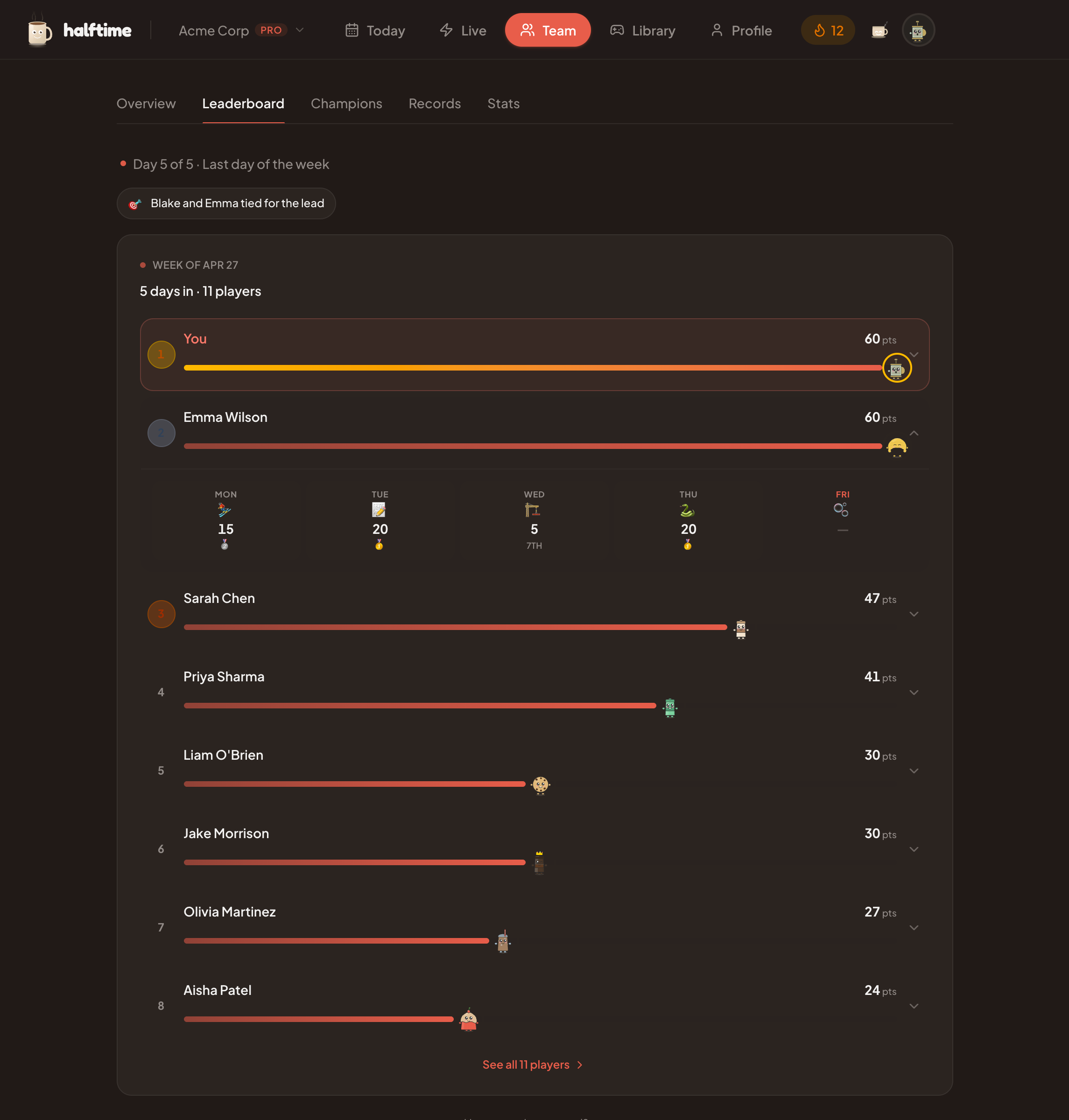
That is enough. The point is not to turn Microsoft Teams into an arcade. The point is to give the team one small shared thing that does not need a meeting to exist.
Teams can carry the reminder and the result. The game can carry the conversation.
If your team runs on Microsoft Teams, start a 30-day Halftime team pilot. The channel gets a daily two-minute game with browser play, leaderboards, and results the team can react to. No card required.
FAQ
Common questions
What are good Microsoft Teams games for work?
Good Microsoft Teams games for work are short, easy to join, work-appropriate, and useful without a long explanation. Async daily games, quick trivia, word games, estimation games, drawing prompts, meeting openers, and lightweight leaderboards usually work better than long hosted activities.
How long should a Microsoft Teams game take?
For normal work meetings, keep Microsoft Teams games under five minutes. For a recurring team ritual, two minutes is usually enough. Longer games can work for dedicated socials, offsites, or team events, but they should not be slipped into normal meetings without warning.
Are Microsoft Teams games better during meetings or async?
Async Teams games are better for recurring team connection because people can play when their day allows. Live games work well as meeting openers, retros, offsites, and Friday socials, but they should support the meeting rather than take it over.
Does Halftime work with Microsoft Teams?
Yes. Halftime can use Microsoft Teams notifications for daily game reminders and ritual moments, while the games themselves run in the browser. Microsoft recommends Teams Workflows webhooks for new webhook-style notification setups.
Do Teams webhooks still work for game notifications?
Yes. Teams Workflows webhooks support lightweight channel notifications. Microsoft says legacy Microsoft 365 Connectors are nearing deprecation and recommends Workflows for new webhook-style posting.
What games can you play on Microsoft Teams with coworkers?
Quick browser games work best with coworkers because nobody has to install anything. Good picks include Five Letters, Over/Under, Timeline, Cipher, Common Thread, Draw from Memory, Tower Stack, and Gone Fishin'. Post the link in a Teams channel or meeting chat and everyone plays in the browser.
Are there free games to play on Microsoft Teams?
Yes. Chat prompts, polls, trivia questions, and bingo cost nothing to run inside Teams. Halftime's public games are also free to play in the browser without an account, and the free team plan keeps a daily puzzle, icebreaker, and joke.