Remote & Hybrid Teams

Rituals, not retreats. Your remote team just needs a daily reason to talk.

A 2-minute game every morning. Played async, across time zones. No scheduling, no awkward video calls, no forced fun. Just a shared experience that happens in the background.

  • Async by default
  • Any time zone
  • Slack, Teams + email notifications
  • Free for teams up to 6
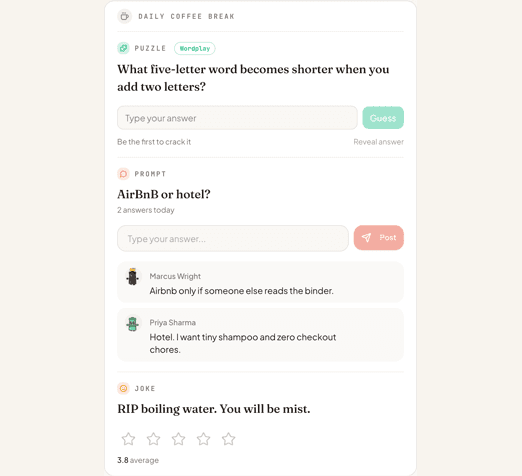
Halftime Today page showing the daily game for a remote team

Some people are chatty in the morning. Some come alive at 3pm. Some work in a different time zone entirely. An async ritual respects all three.

Your remote team doesn't need another meeting. They need a reason to talk.

Remote work solved the commute problem and created a connection problem. Your team is productive but disconnected. The fix isn't more Teams calls. It's a daily shared experience that happens in the background.

The gap remote work created

In an office, connection happens by accident. You bump into someone at the coffee machine. You overhear a conversation and jump in. You learn that your colleague coaches their kid's footy team because you see the photo on their desk.

Remote work removed all of that. What's left is meetings, messages, and tasks. Efficient, but sterile. People work side by side for years without knowing anything real about each other.

In-office

  • Kitchen chat every morning
  • Desk-side jokes throughout the day
  • Lunch together without planning it
  • Overhearing conversations, joining in
  • Knowing people as people, not just roles

Remote

  • Slack messages about tasks
  • Meetings with agendas and outcomes
  • Camera-off standup calls
  • Annual offsite (if budget allows)
  • Knowing people as names in a thread

Close the remote connection gap

Free for teams up to 6. Async by default. Works with Slack, Teams, or email.

Why "social" meetings don't fix it

  • Time zone friction. Finding a time that works for everyone across 3+ time zones means someone is always inconvenienced.
  • Meeting fatigue is real. After 6 hours of Teams, the last thing anyone wants is another call, even a "fun" one.
  • Extroverts dominate. Live social calls reward the loudest voices. Quiet people sit through them silently, then feel worse than before.
  • It's once a week at best. One social call a week can't compensate for the 40+ hours of silent, transactional work surrounding it.

What remote teams actually need: async rituals

The fix isn't synchronous. It can't be, because your team is in different places and different time zones. What works is an asynchronous shared experience, something everyone does on their own time that creates a shared reference point.

That's what Halftime is. A new game shows up every workday. People play when they have 2 minutes. Scores go on a shared leaderboard. The conversation happens in Slack, Teams, or wherever your team already talks.

Built for distributed teams

Async by default

No scheduling required. The game shows up in the morning. Your teammate in London plays at 9am, your teammate in Melbourne plays at 9am. Results are revealed at a time you set. Everyone participates, no one is inconvenienced.

Works where your team already is

Notifications go out via Slack, Microsoft Teams, or email. No new app to install. No new tab to remember. The game is one click away from where people already work.

Live sessions when you want them

When the team IS on a call together, start a live session. Share a link, everyone joins instantly. Real-time multiplayer in 2 minutes, no plugins, works during any video call.

Equalises introverts and extroverts

Games don't favour the loudest voice. The quietest person on your team can top the leaderboard. Everyone participates on equal footing.

It lives where your team already is

A daily notification in Slack or Teams. Results revealed at a time you set. No new app, no calendar juggling, no video calls.

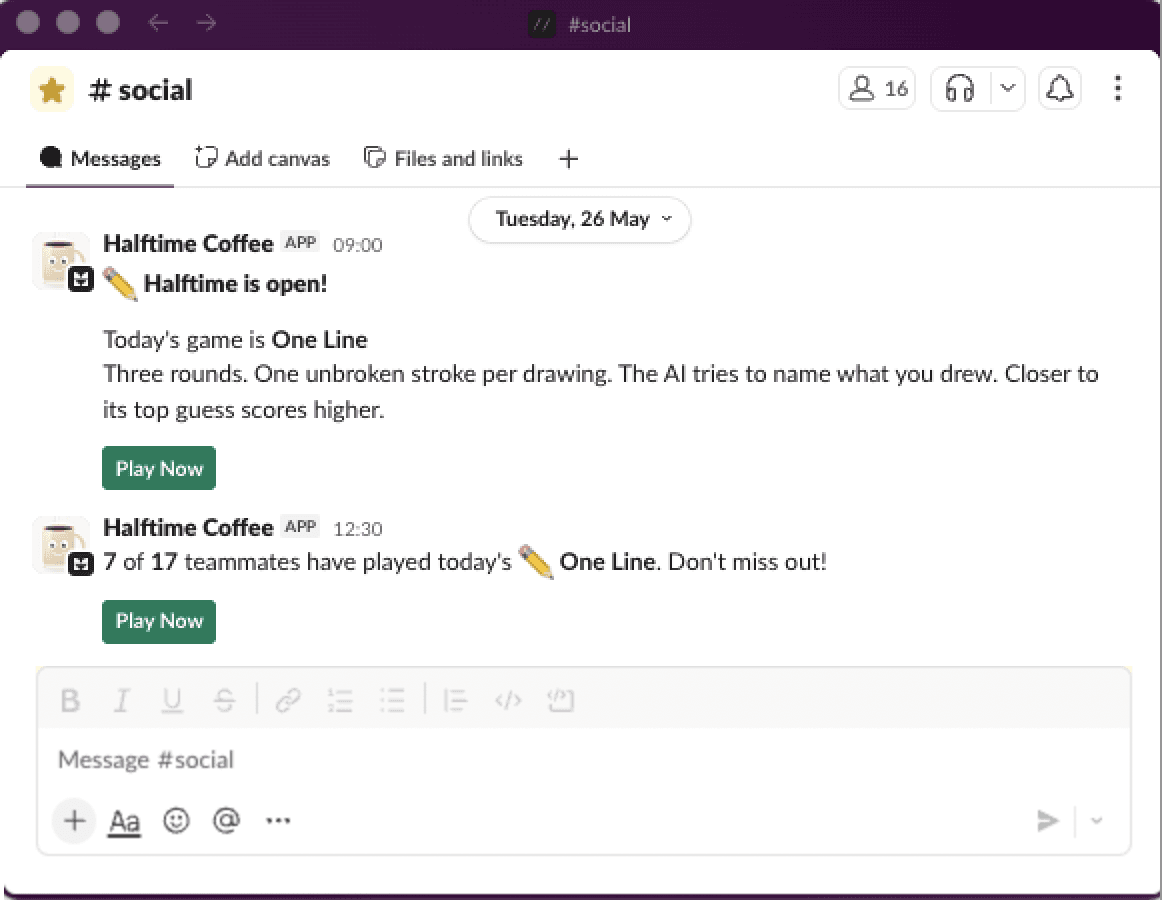
Slack notification announcing today's Halftime game to the team

Morning notification

The game drops into Slack (or Teams). Your teammate in London plays at 9am their time. Your teammate in Melbourne plays at 9am theirs.

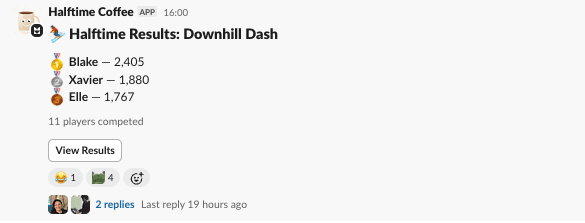
Slack results announcement showing the day's leaderboard and top scores

Shared results reveal

Everyone sees the same leaderboard at the same time. Banter starts. The remote team has a reference point they all share.

What changes across time zones, and when

Week 1

First game drops. Someone in London and someone in Melbourne play the same challenge eight hours apart.

Week 2

The Slack channel has banter for the first time in months. People react to results with emojis at 3am.

Month 1

Running rivalries form across time zones. Standups feel less transactional because people actually know each other now.

Month 3

Your remote team knows each other as people, not as names in a thread. You notice it in how they collaborate.

Connection that compounds

The real value isn't any single game. It's the accumulation. Streaks that people protect. Rivalries that become running jokes. Inside references that make standups feel warmer. Over weeks and months, your remote team starts feeling like an actual team, not a group of strangers who happen to share a Slack workspace.

Flat-rate pricing, no per-seat fees

Free for teams up to 6. Starter is $19/mo for up to 10. Pro is $39/mo for up to 25 with custom scheduling and analytics. Business is $99/mo for up to 75 with groups and department leaderboards. No per-seat calculations.

Common questions

How does this work across time zones?+

Each workday, a new game drops in the morning. People play whenever they have 2 minutes. Results are revealed at a time you choose, so a teammate in London and a teammate in Sydney both participate without anyone inconvenienced.

Does it really integrate with Slack and Teams?+

Yes. Notifications go out via Slack, Microsoft Teams, or email, linking straight into the game. No new app to install, no new tab to remember.

What if our team has people who hate this kind of thing?+

It's voluntary. Nobody's forced to play. Games are async and private to your team, so the introverts on your team can participate or not without pressure. Most end up playing because it's low-stakes and quick.

Do people actually play if it's optional?+

Our most engaged teams see 70–90% participation by week two, because the games are short and the banter is the reward. If nobody on the team finds it fun, it won't work, and you won't have wasted anything on the free plan.

How long does setup take?+

About 30 seconds. Pick your active days, pick the time results are revealed, connect Slack or Teams if you want. That's it.

Can we try it before signing up?+

Yes. The /try page lets you play a game solo without an account so you can see what your team would be playing.

Notes from Blake, Halftime founder.

Give your remote team a daily reason to connect.

Play a game right now, no signup. Free for teams up to 6 when you're ready to bring them along.

Connect Your Remote Team Without Another Meeting | Halftime | Halftime