Solutions · Employee engagement
Employee engagement software that creates participation.
Surveys tell People teams how engagement is going. Halftime gives employees one small, optional reason to show up, play, compare, and talk every workday.
Full access for 30 days · No credit card · No surveys
 Slack
Slack Teams
TeamsEvaluating for your team? Book a 15-min walkthrough →
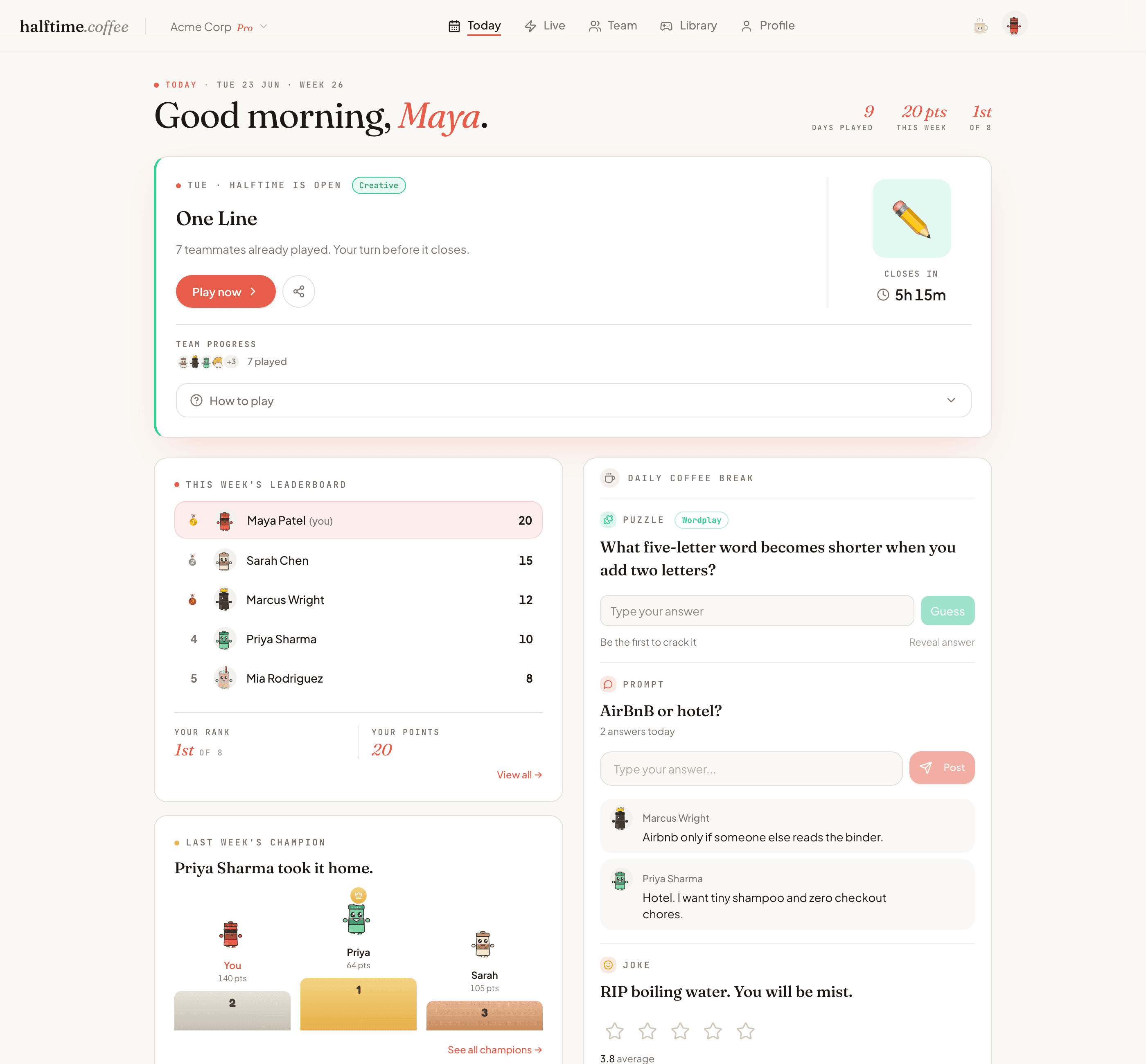
Surveys measure feeling. Halftime builds it.
Culture Amp, Lattice, Officevibe, eNPS pulses. They're diagnostic instruments. Halftime is the intervention: a small daily ritual teams genuinely look forward to. Two minutes, async, no facilitator.
Turning survey results into action? Start with what to do after an employee engagement survey, check whether connection is the issue with the team connection assessment, or read the deeper argument behind the daily-ritual approach in The Case.
Two minutes a day. Played whenever.
A new game opens at 9. Each team member plays whenever there's a moment. Coffee, a break, between meetings. By 4pm scores reveal, the leaderboard updates, the conversation starts.
A fresh game, daily
One 2-minute game opens for the whole team every workday.
Played in the gaps
People take their shot whenever they have a spare moment, with no call to join.
The team shows up
By lunch most teammates have played and the chatter starts.
Results reveal together
Scores drop at the end of the day and the weekly leaderboard refreshes.
Participation without nudging. Conversation without prompting.
The useful signals show up quickly: participation, chatter, and who keeps coming back.
Week 1
Participation becomes the first signal. People start checking scores without a manager nudging them.
Week 2
"Have you done today's yet?" becomes a thing people actually say. Rivalries start.
Month 1
Quiet teammates show up here who never speak in meetings. Mid-day chatter in Slack.
“The games have been really fun. The team has really enjoyed the various games. It came at a perfect time. We were experiencing low morale across the team and your app boosted morale within days.”
Measure vs create
Keep the survey. Add something people actually do.
Engagement programs usually fail when measurement becomes the whole program. Halftime gives the next pulse survey a real behavior to measure.
Survey platforms
Measure sentiment and trends.
They tell you people feel disconnected after the fact.
Calendar socials
Create occasional shared events.
They add another meeting to people who are already overloaded.
Halftime
Create one tiny daily interaction.
It gives the next survey something real to measure.
How it is different
Events end. Surveys measure. Halftime is a daily habit.
Common questions
Is this a replacement for our engagement survey?+
No. Surveys measure how people feel. Halftime tries to change it. Different jobs. Most teams keep their survey for measurement and run Halftime alongside it as the thing that actually moves the numbers.
How is this different from Culture Amp, Lattice, or Officevibe?+
Those tools measure engagement. Halftime creates daily participation. They send surveys and produce dashboards. We send a 2-minute game and produce conversation. Most teams use measurement and intervention together.
What's the setup effort?+
About 30 seconds. Pick your days and times, connect Slack or Teams if you want, done. No content to create, no facilitators to train.
How should People teams pilot Halftime?+
Start with one team for 30 days. Make participation optional, let Halftime run the daily ritual, and watch whether people return, compare scores, and keep talking without manager prompting. If the habit sticks, expand it to more teams.
Pricing?+
Every team gets a 30-day free trial with full access, no credit card. After that you keep a daily puzzle for free or subscribe to Pro at $39/mo flat for the whole team. Yearly is about 10% off. No per-seat fees.
Ready when you are
Turn one survey finding into a 30-day team pilot.
Start with one team, keep participation optional, and see whether the ritual sticks. Full access for 30 days, no card required.